Frontier-class science,
at the point of production.
ARCNet is the operating system for autonomous distributed manufacturing — the secure orchestration, control, data, and learning layer that connects ORNL-class scientific compute to distributed edge nodes that can discover, design, simulate, produce, inspect, test, qualify, learn, and redeploy.
Progress depends on two substrates.
Today, both are broken.
Centralized manufacturing cannot meet the tempo of contested logistics, attritable systems, or frontier energy. The constraint is not cost-per-part — it is time-to-capability, qualification speed, and survivability under degraded networks.
An integrated manufacturing platform gives them a qualified part with a cryptographic chain of custody, and a direct lineage to a verified simulation that specified it.
Seven layers.
One model that binds them.
ARCNet is not a printer and not a network. It is the seven-layer stack every physical part passes through — discover, design, simulate, produce, inspect, test, qualify — and ADAM is the foundation model that learns from all seven and closes the loop back to design.
ADAM.
The world's preeminent foundation model for advanced manufacturing.
Autonomous Resource Corporation has been given the mandate to commercialize a combination no one else can assemble: exascale compute at OLCF · the Manufacturing Demonstration Facility at Oak Ridge · fiber between them · and the ARCNet fleet that supplies the problem-sets. ADAM — Autonomous Discovery & Advanced Manufacturing — is what that loop produces.
A non-replicable loop. One model at the center.
No other operator has this triangle. Exascale HPC exists. A world-class manufacturing science lab exists. A commercial deployment fleet exists. They have never, until now, been closed into a single loop — let alone under a single commercial mandate. ADAM is the model that loop trains.
Frontier ↔ MDF. Three years, billions invested, one of a kind.
ADAM isn't a bet on whether this loop can be built. At Oak Ridge, it has been running for years — coupling exascale compute to instrumented manufacturing science at a scale no other operator commands. The instrument, the science, and the training discipline all exist, today.
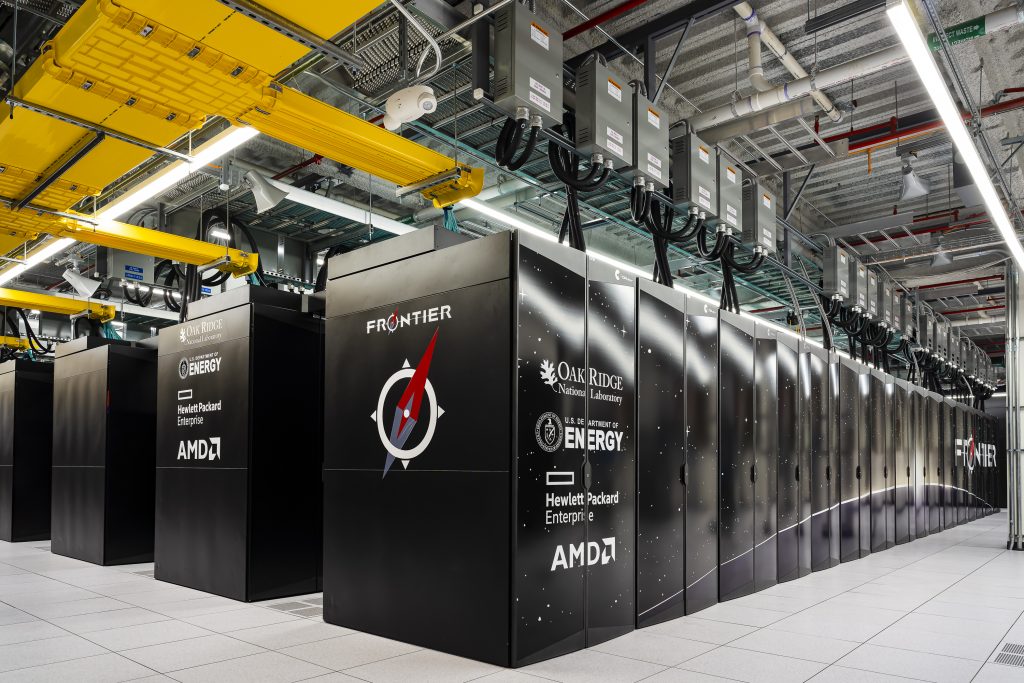
What ORNL built stops at the lab perimeter. ARC carries the same loop out to every fielded node — so each site becomes a training input, not just a training output. Hundreds of thousands of problem-sets per year, from real production, back into the same model.
No other company in the world has this training engine. And won't, for years.
OLCF Frontier was a three-year, multi-billion-dollar commitment. MDF's instrumented knowledge-factory is the product of a parallel decade of DOE-scale investment. The combination — exascale compute, fiber-connected to an instrumented manufacturing science stack, with a commercial mandate to deploy it to the edge — exists at exactly one address on Earth. ARC has the commercialization right.
One set of interfaces.
Five deployable envelopes.
Every class shares the same orchestration interfaces — job intake, command payload, telemetry emission, model release, evidence transfer, attestation. ADAM is distilled onto each class and runs as the inference engine at the node; the same model that trains on the hub governs the layer being produced right now.
ORNL Scientific Hub
Simulation, model governance, foundation-model training, qualification policy.
Regional Hub Node
Regional command, fleet retraining, high-density compute, surge support.
Production Node
High-throughput production, local control, anomaly handling, evidence generation.
Test & Qualification
Third-party-like verification, regional qualification support, failure analysis.
Scout / Tactical
Forward sustainment, diagnosis, redesign approval, evidence intake.
Authority at the hub.
Autonomy at the edge.
ORNL is the scientific authority; Frontier and Lux run the simulations. Distributed nodes execute locally with bounded autonomy — regardless of what tooling sits behind the interface. The message plane is deterministic and token-gated.
The hub issues the science. The edge runs with it. ORNL computes a process-specific payload on Frontier / Lux and pushes it under cryptographic attestation; the node executes locally inside a Vera Rubin secure enclave with sub-2‑second decision-to-command; only the deltas — mathematical, evidence-bearing, scrubbed — return to the hub. Reverse-engineerable geometry never leaves the node.
Seven nodes. One hundred thousand
hot-section engine parts.
ARCNet is tooling-agnostic — but to prove the platform, we need a first concrete instantiation. The Alpha beachhead is metal binder jet (MBJ) + nickel superalloys, producing hot-section components for expendable drones. Same interfaces; one specific payload behind them.
Modality
Materials
Closed-loop control
Product
Not a compliance checkbox.
The deployability mechanism.
ARCNet's zero-trust architecture is what makes the platform deployable in contested, regulated, and allied-nation environments. Mapped to CMMC 2.0 Level 2 and NIST SP 800-82 out of the box.
NVIDIA Secure Enclaves
The print payload — phase-field parameters, pre-deformed CAD, binder saturation maps, sinter curves — is processed entirely inside Vera Rubin TEEs. A root compromise of the rack's host OS does not reveal the CUI.
Cryptographic remote attestation
Before Frontier transmits any powder-lot data, the edge must present a valid firmware / OS / hardware root-of-trust hash. Attestation failure = downlink severed, immediately.
Machine-to-machine mTLS
Every printer, camera, and furnace holds a unique X.509 certificate. Rogue devices are ignored — no handshake, no data. Purdue Model segmentation at L3/3.5 by the Vera Rubin rack.
Token-ring uplink gate
No node transmits telemetry to ORNL unless it holds the cryptographic ARCNet token. The ring is deterministic, which neutralizes DDoS and rogue-node injection. Consensus recovery on stall < 30 s.
Crypto-shred on evidence seal
NVMe is self-encrypting. Job-specific keys are destroyed on evidence seal — terabytes of CUI become mathematically irreversible ciphertext in a single destruction event. The destruction itself is audit-logged.
Role projection at data boundary
A Line Technician can't accidentally leak geometry because the projection never hands them geometry. Four roles — Metallurgist · Operator · Site Manager · Line Technician — strictly scoped at the store, not the UI.
From superalloy beachhead to continental-scale autonomy.
Four phases — Alpha through Delta — named for mission posture, not marketing. Bravo, Charlie, and Delta are architecture-driven expansion aligned with the reset.
Superalloy beachhead
Evidence & qualification
Multi-modality & regional hub
Tactical & contested
Qualification, productized.
Test & Qualification Nodes stood up operationally with CT, NDE, microscopy, coupon mechanics. Evidence packages accepted by aerospace primes. Fleet-wide model updates flow OTA through the token-ring gate to every attested node.
Manufacturing at the tempo of intent.
The next industrial base won't build itself.
We're onboarding a small cohort of facilities, labs, and mission partners ahead of Phase Bravo. If your operation maps onto distributed manufacturing, contested logistics, or qualification-bound production — the room is small, and it's open now.